New York-based companies raised $13 billion in venture funding in the third quarter. That brings the total to nearly $39 billion through September, more than double the $17.8 billion raised over the same period of 2025. Over the same stretch, the city's private sector shed 23,000 jobs in September, which brings the year-to-date loss to 16,300.
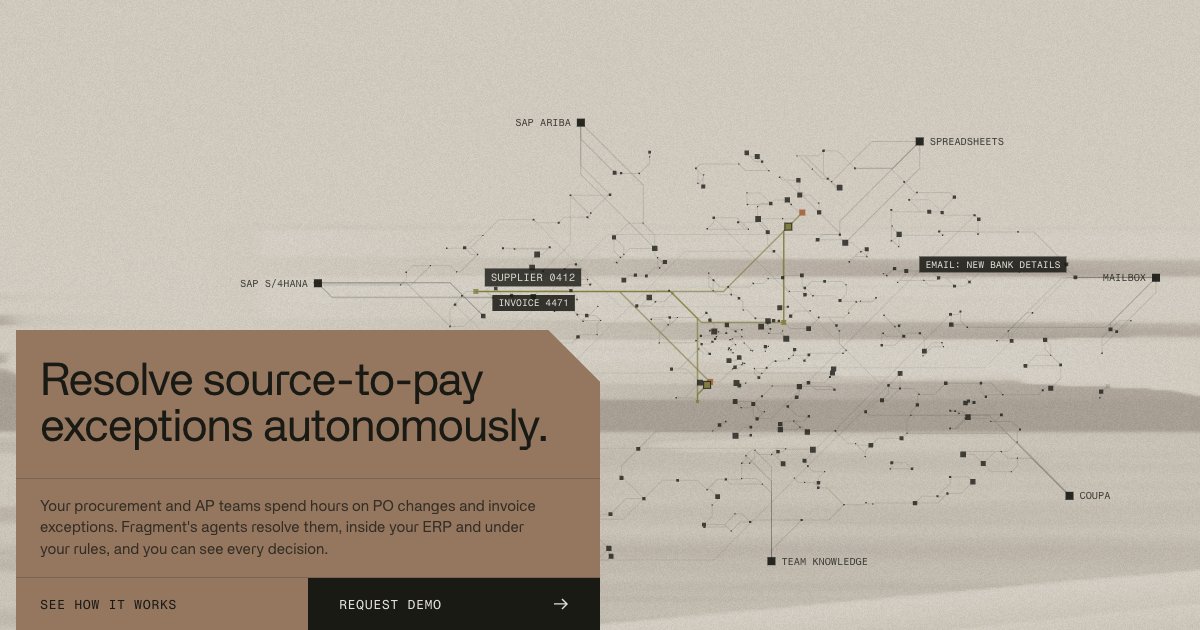
Fragment, a procurement software company, has raised $56 million, according to a post by Pranav Mulgund dated 28 October 2026. The company's site also announces a Series A financing.
Fragment sells software that resolves source-to-pay exceptions, such as purchase order changes and invoice disputes, inside a customer's existing ERP. It has two parts. The Autonomous Context Engine maps a customer's systems and data and learns its business rules, and agents then use that to carry out the resolution. The company says it builds for enterprise manufacturers that buy direct goods, and that every agent decision can be audited. It cites Ardent Partners for an average enterprise invoice exception rate of 22%.
Its main reference customer is Flex. Fragment reports a 91% touchless rate there, four weeks to production, and 100 of 134 FTEs redeployed. Rodrigo Dall'Oglio, President of Operational Excellence & Transformation at Flex, said the company's own 18-month machine learning effort "capped out around 30% touchless".
Kalshi, a prediction market operator based in New York, has raised a $1 billion Series G at a $40 billion post-money valuation. The company was valued at $22 billion in May. Sequoia Capital and Wellington Management co-led the round. Baillie Gifford, Morgan Stanley Investment Management, Coatue Management and Andreessen Horowitz also participated.
Beyond Reach Labs, based on 1st Avenue in Brooklyn, sells deployable solar arrays called Flarewing in three standard configurations. Flarewing-S has a deployed area of 30 m² and a maximum beginning-of-life output of 5 kW per wing with silicon cells or 8 kW with triple-junction cells. Flarewing-M covers 180 m² and delivers 35 kW or 55 kW. Flarewing-L covers 625 m² and delivers 125 kW or 200 kW. The L stows in a 6.00 × 0.29 × 0.13 m envelope.
The company is aiming at a structural limit. As solar arrays get longer, their first bending mode frequency drops, which makes them susceptible to vibrations that interfere with spacecraft pointing and control. Traditional designs have had to choose between stiffer and heavier, or shorter and less powerful. Beyond Reach says Flarewing delivers orders of magnitude more power per launch.
Mitch, co-founder and chief executive, holds a PhD from Carnegie Mellon University and has worked in robotics and aerospace. Co-founder and chief technology officer Pele Collins spent seven years at SpaceX leading the Dragon parachute systems team.
I can't write this story from the source provided. The text is a Bloomberg bot-detection page, not the article. It has no information about Fluidstack, the $40B valuation, investors, the size of the round, or any quotes. The headline is the only usable fact, and it can't be repeated or padded out to 120 to 180 words without inventing detail.
If you can send the article text, or another source that covers the report, I'll write the piece to the house rules.
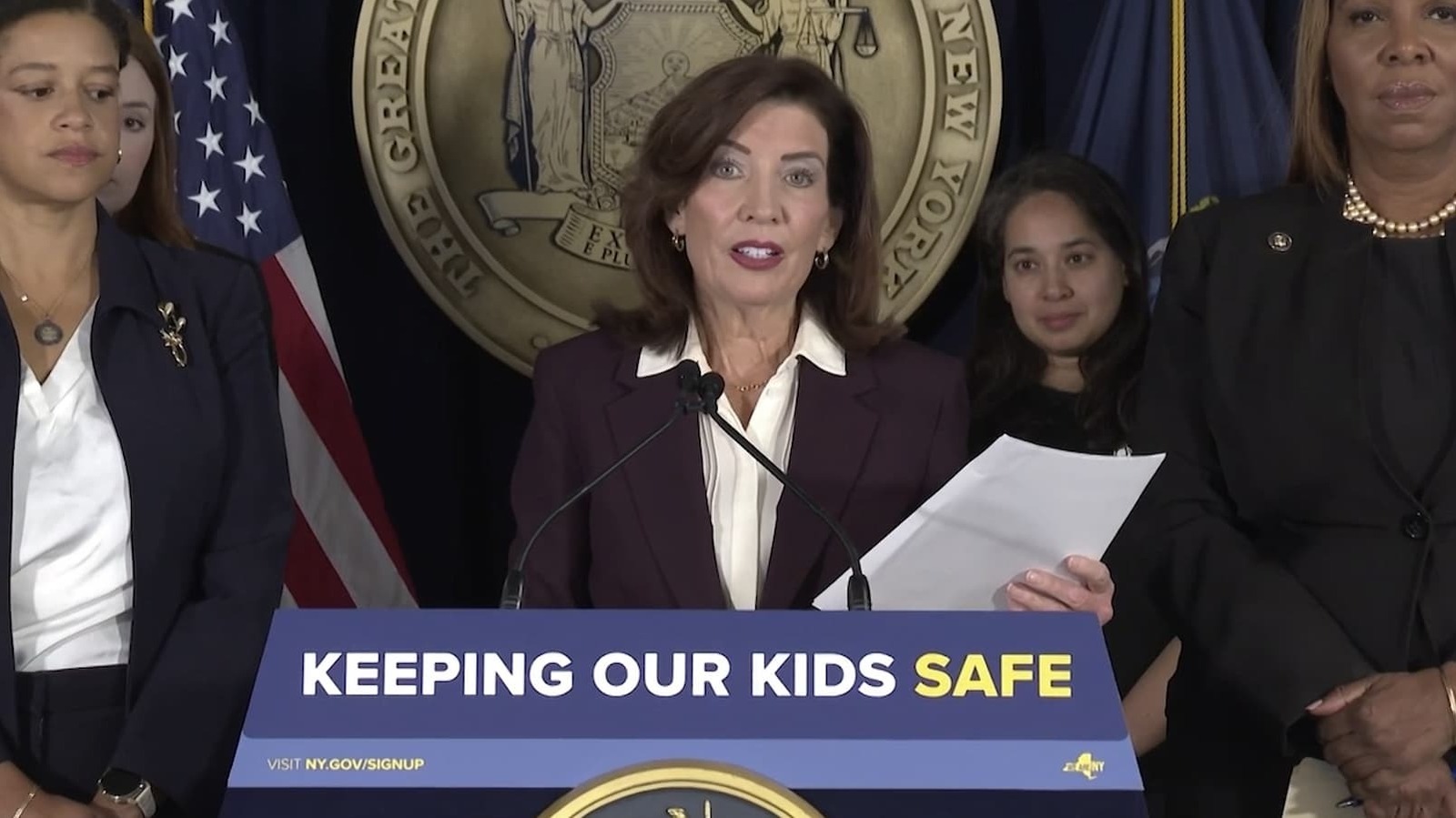
New York Governor Kathy Hochul has signed a law requiring AI companies to verify the ages of chatbot users. Companies must offer at least one verification method that does not rely entirely on government ID, and must delete the age information after use. Users under 18, or not yet confirmed as adults, must get a chatbot that cannot pretend to be a real person or claim human emotions. It also cannot claim a romantic relationship with a child. The law takes effect in six months.
The public will be able to file complaints with the attorney general through a website. Companies that break the law may face civil penalties of up to $25,000 per violation, plus damages and restitution, and may have to delete unlawfully collected data and models trained on it. Jim Steyer, founder and CEO of Common Sense Media, called it "the strongest kids' AI safety bill in the country". Earlier this month, eight states sued OpenAI, accusing it of endangering children. A separate law on internet-connected baby monitors takes effect in 90 days.
AI tools bought from specialised vendors succeeded about 67% of the time in MIT NANDA's 2025 research, against about a third of the time for tools built internally. The figures arrive as software bills rise. The average organisation in Zylo's 2026 SaaS Management Index spends $55.7 million a year on SaaS, up 8% in a year, and more teams are asking whether to build instead of buy.
The case for building rests on the first cost. In an illustrative example, two engineers with an AI coding assistant working for a week cost roughly $7,700 in salary, against a tool that costs $30,000 a year. The counter-argument is upkeep. In Stripe's Developer Coefficient survey, developers estimated that 17.3 hours of a 41.1-hour week go to maintenance, about 42%. In an Anthropic trial, developers who used AI scored 50% on a quiz about the code they had just written, against 67% for those who coded by hand. The analysis recommends building small, low-risk tools with a written exit, and buying anything whose failure would be catastrophic.
Ben Lerer, managing partner at LH, spoke at the Crain's New York Tech Summit about why the firm is bullish on New York tech and the range of ideas the city's ecosystem offers. Comparing New York with the west coast, he said: "San Francisco is a one-note town."
Research from Tech:NYC and Accenture found that postings seeking AI or machine-learning skills nearly tripled over the past year. They now account for nearly 14% of all advertised jobs in the city, more than twice the national rate. New York has more than 2,000 venture-backed AI companies, which added an estimated 26,000 net jobs over the same period.
PatternMD, a symptom-tracking app launched in April 2026, has signed up more than 500 users in English, Spanish, German and Vietnamese. It was accepted into the VA PathFinder Innovation Repository in May 2026. The app is free to patients, who log physical and mental symptoms while it records weather, air quality, sleep and workouts alongside each entry. Other users see only an anonymous PMD-ID, never a name or photo.
The company is bootstrapped. Revenue is meant to come from organisations, through sponsored placements from health organisations and paid access for researchers and health systems to aggregate, consent-based data. The provider portal is free to clinicians for now. Founder and CEO Pedro Infante said anonymity is the default because "there is no identity to leak, sell or subpoena."
Next, PatternMD expects a decision this fall on its NIH SBIR application, which is under review at the National Institute of Mental Health. It also wants a first provider-portal pilot with a New York clinic or health system.
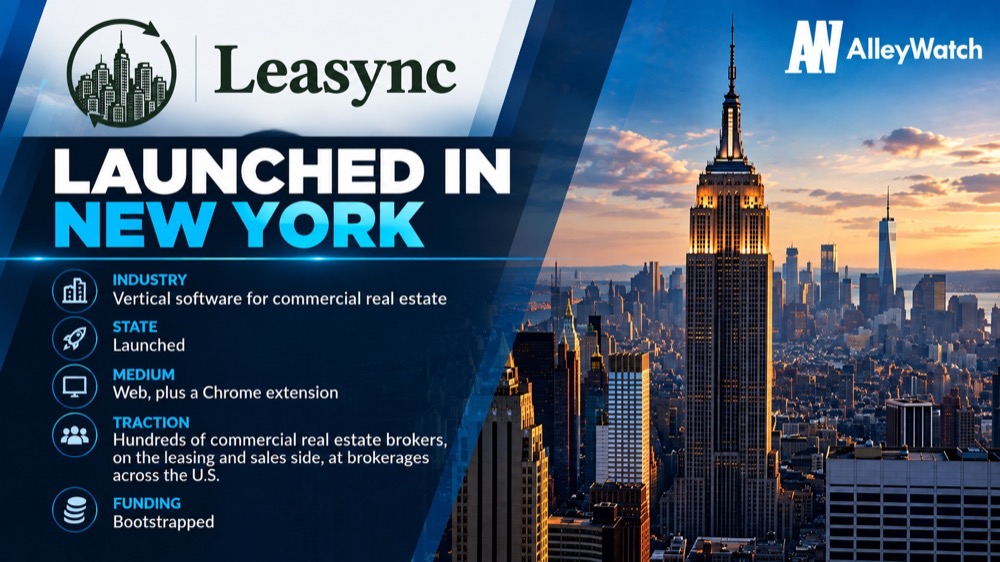
Leasync, a New York company that makes a CRM for commercial real estate brokers, now serves hundreds of brokers at brokerages across the U.S., from solo brokers to full firms. The product began inside a Manhattan boutique brokerage, which still runs live deals on it every day. It covers leasing and sales, linking tenants and buyers, properties, landlords, deals and commissions in one system.
Its built-in AI assistant, Lisa, builds a prioritised daily agenda from the whole account, summarises emails and files the contact. Given a letter of intent, it fills in the deal, including the commission and any co-broke split. Cofounder Aaron Aziz has worked on Manhattan commercial deals for more than a decade and runs the brokerage ARA. Of the CRMs he tried, he said, "none of them spoke a broker's language." His cofounder Mason Kalaty, who founded the software firm Uptick, wrote the product from the first line of code.
Pricing is a monthly subscription per broker, posted publicly, with brokerages adding seats. The company is bootstrapped, with no outside money. Over the next six months it plans to grow outside New York, make Lisa more useful and keep shipping new features weekly.
Isabelle Phelps, a partner at Lerer Hippeau, expects some of the biggest companies of the next five years to look more like services businesses than software companies. She made the prediction in an interview published on 22 October 2026 in the firm's VC Spotlight series, and said she expects New York to produce many of them.
Her reasoning is about margins. "For a long time, venture steered clear of services because of the margins, and AI changes that math," she said. Instead of selling a tool and hoping the customer adopts it, she argued, a small team can now deliver the outcome itself, such as doing the accounting, collecting receivables or automating a factory line. She pointed to the city's depth in professional services as the reason New York should be well placed.
Lerer Hippeau invests at pre-seed and seed stage, usually as lead or co-lead. Phelps joined as a summer associate, became an associate after graduating from MIT, and is now a partner. The interview does not name any dissenters.
Reported by technyc.org, via Lerer Hippeau, 2026-10-29
Charles B. Johnson took over the family business in 1957 at the age of 24. It had $2.5M in assets, $10,000 in revenue and one part-time employee, and he paid himself $300 a month. His father, Rupert H. Johnson Sr., had founded the firm in New York in 1947 and named it for Benjamin Franklin. Most managers at the time offered a single fund. Franklin crossed $1B in assets in the early 1980s.
Franklin Templeton now manages $1.8 trillion, more than $300 billion of it in alternatives. In August the parent company dropped the Franklin Resources name and took the Franklin Templeton name, keeping the $BEN ticker on the NYSE. Jenny Johnson started in the mail room at 14 and became chief executive in February 2020. The firm has made 17 acquisitions in six years, including the $4.5B Legg Mason deal. Of acquirers generally, Johnson said: "A big mistake that people who are acquirers do is they just assume that their team is the best team."
Reported by sourcery.vc, via Molly O'Shea, 2026-10-30
Anthropic reported revenue of $16.3 billion in the first half of 2026 in the S-1 it filed on Monday, against $4.6 billion for all of 2025 and $41 million in 2023. The filing also shows a first-half net loss of $80.7 billion. Of that, $72.4 billion was a fair value charge on convertible notes and SAFEs, which became more expensive as the company's valuation rose. The GAAP operating loss was $693 million.
On an adjusted basis, operating income was a $1.6 billion profit, compared with a $1.8 billion loss a year earlier. By Opening Bell Daily's calculation, compute and infrastructure costs were 48% of revenue in the second quarter of 2026, down from 251% in the first quarter of 2025.
The commitments are large. They include at least $110 billion with Amazon, whose deal runs through April 2036, and at least $44.9 billion with Microsoft. Stated amounts for seven named deals total roughly $637 billion, with about $430 billion of that in minimum spending or fixed lease payments. The filing gives no IPO date. Bloomberg reported that formal marketing could begin as soon as early November.
San Francisco "one note town" Thats fighting talk. I tend to operate at the grass route levels Seed, Series A and I have to say my experience isn't the monotone picture Ben Lerer suggests. I see passion and ideas in all my interactions in the bay.
Though I also see AI becoming the basis of all investment, regardless of use case. We do need to get back to making profitable companies that solve problems people are willing to pay to solve.
Tech for the sake of Tech isn't a business, it's a weekend project.